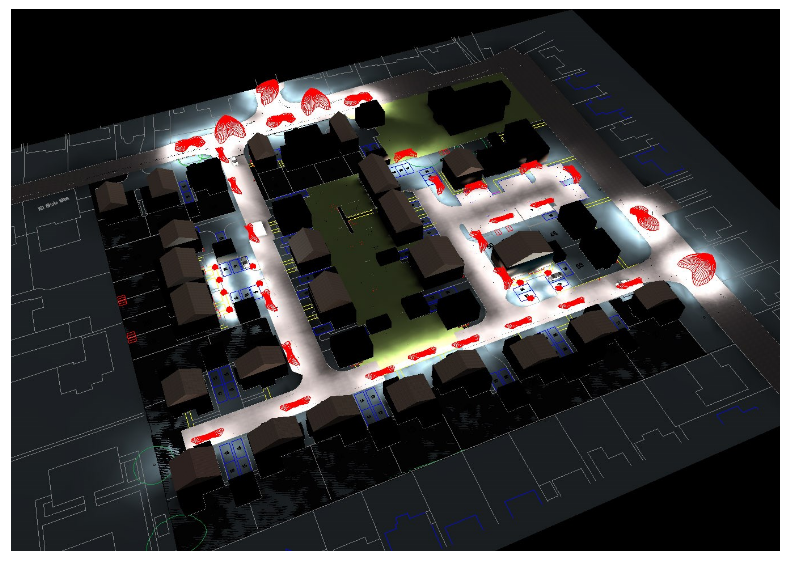
Highway Lighting Guide
Principals for Highway Adoption and Private Highway Lighting
Survey & Evaluation – Proposals & Concept – Design & Detail – Automation & Controls
Contents Include
- Private Cable Networks
- Adoptable Highway Section 278 Works
Related to Developments joining an Adopted Road Junction - Adopted Highway Section 38 Works
Related to Developments with Spine Roads, where lightingforms a component part
Adoption Process
This is the means where an agreement is in place for the Developer to install Local Authority approved lighting and electrical components, to the satisfaction of that authority, In order that the future maintenance of that equipment and running costs are transferred to the Local Authority.
The DNO (District Network Operator) provides unmetered supplies for the Local Authority, or for developments with Feeder Pillars for Private Metered connections for Private Cable Net- works (PCN).
For Private Network Cables, the developer is free to use whatever equipment is preferred that is meeting with all safety standards. In such cases, the developer should put in place a maintenance contract, means of management and evidence of performance to the contract for the upkeep and improvements to the estate.
Where the entrance meets a public road (Adopted), the first lighting location is critical to meet the requirements of the section 278 agreement. Which would represent the majority of all developments with highway works.
Design Manual for Roads and Bridges DMRB
Any Public lighting system for private roads or adoptable roads, shall follow the requirements and construction guidance methods stated in this public document.
This document also sets out and makes reference to other standards to be followed. This requires co-operation between the Architect, developer and principal stakeholders.
In all cases. To determine lighting performance levels, the road requires that a risk assessed be carried out to define a Road Lighting Category, and thereby performance requirements. This re- quires some expertise.
Private Cable Network
An Example.
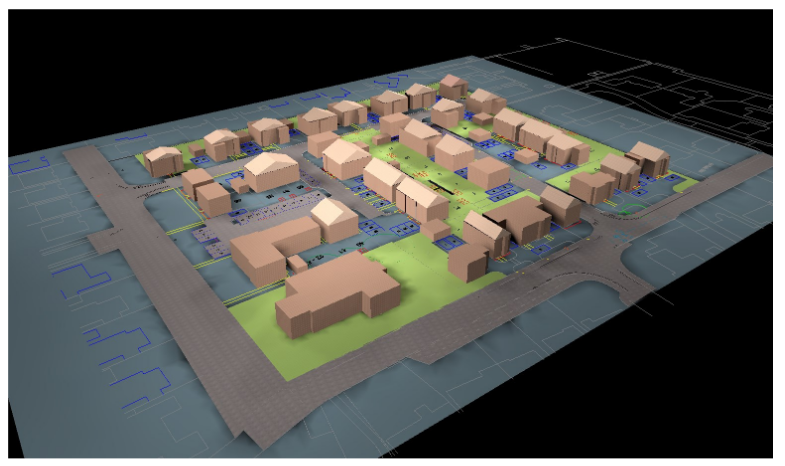
The following example shown represents in this case a private Development with a PCN Lighting layout. The process shall follow the following guidance of
The Right Light, In the Right Place , At the Right time, with the Right Controls
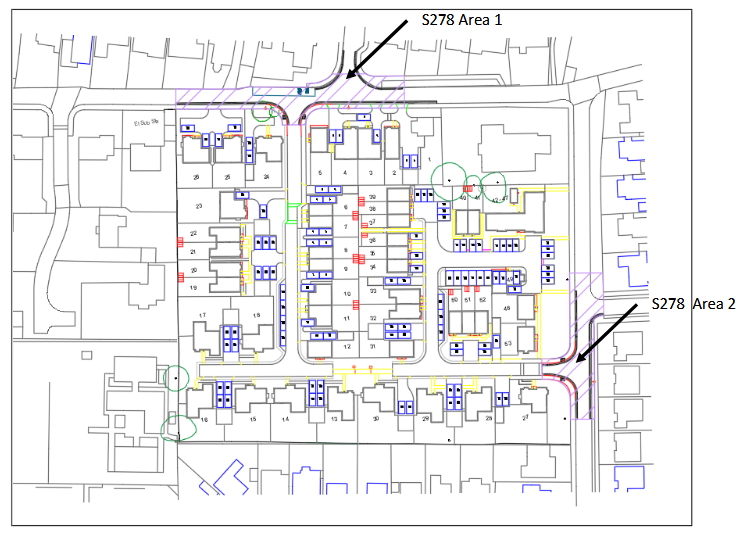
The above example shows 2 entrance roads with a joining path.
For every development joining an adopted highway, the junction requires a local authority SECTION 278 agreement.
This agreement requires evidence of continuity of lighting on the adopted highway from the proposed lighting (typically first column) within the development.
In a PCN proposal, the product used on the development is not important, but the performance and distribution affecting the adopted road IS.
The Do’s
♦ Flat 2D plan
♦ Lights the Floor
♦ Square or Rectangle array for floor area lighting
The Don’ts
♦ No ability to assess performance
♦ No ability to assess Glare, or Contrast
♦ Little appreciation of Photometric properties of lighting
Private Cable Network (Cont.)
For even a PCN proposal, evidence of safety must be provided, but the choice of product isb within the control of the developer, who may choose a specific style. The method of calculation however, takes into account the durability and optical longevity of the product, therefore you can assume the cheaper the product, the higher the performance target and higher maintenance costs will follow.
Evidence of performance and/or modelling effects will be required for the horizontal plane, where the performance achieved considers the population density and the built environment in which the development may sit. The population density gives rise to Environmental Zones where obtrusive light limitations, and also limitation to Skyglow exist.
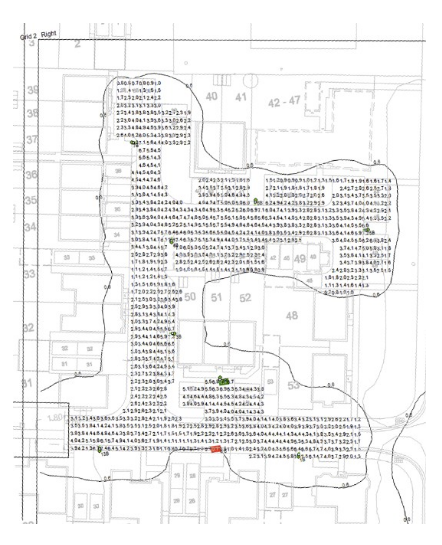
Performance results such as those shown left should be transferred to the base proposal drawings along with evidence of calculation as supporting safety evidence within the clients construction files as required in the Construction, Design and Maintenance Regulations (CDM)
For PCN proposals, the electrical and signage requirements for the estate are the responsibility of the developer.
Under CDM, the developer will be required to evidence safety of the electrical layouts, chambers and terminations and handed to the owners as part of the construction technical file. The same is true of signage.
PCN Recommendations
The first column location on the junction is the most important, as performance and column spacings stem from this location.
It is often forgotten that performance requires not just the right light levels but also uniformity is a key factor. Uniformity helps with the perception of safety.
- Use products with good optical control
- Use products which provides longevity for the LED array.
- Consider the environment, use warmer colour temperatures 2700K to 3000K. Any difference in output is now quite negligible. This separates your development from a local Authority scheme.
- Avoid luminaires with upward light above 90 degrees, this avoids Obtrusive light issues.
- Balance glare control. Controlling glare, make the development more desirable and has a perception of a safer environment when coupled with uniformity.
Adoptable Highway Section 278 Works
An Example.
In the following example, the estate could be either a PCN (Private) scheme, or a Section 38 adoptable estate. This element concerns just the road junctions adjoining existing roads, and concerns safety at each junction. The process shall follow the following guidance of
The Right Light, In the Right Place , At the Right time, with the Right Controls.
Risk assessments are required related to the junctions, location and traffic flow. The deciding factors as to how each junction is to be decided depends on the speed and visual acuity required for that junction. Such junctions may be deemed to fall into either one of the following options:
♦ Junction maintained as a Subsidiary Road, or,
♦ Junction maintained as a Conflict Area
Evidence by calculation showing the existing adoptable highway lighting and, those of the proposed development that maintain the performance requirement and uniformity at the junction.
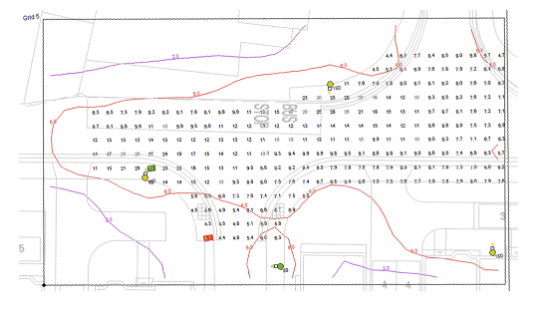
Adoptable Highway Section 278 Works
In these such cases, it is to be remembered that the client is now actually the local authority.
The approval of the highway lighting modifications is linked to the planning conditions. Where there is a requirement to move any column locations, these are likely to be DNO supplies, and cost of moving and/or transfer of services to a new location will have cost implications to be borne by the developer.
Cost of moving illuminated signage and bollards may be less, as these may frequently be fed from an adjacent column as a private Local Authority supply. Full reports, Evidence of Risk assessments, Drawing details, for layouts, electrical, trial holes, schedules will be required for submission.
Consultants are required for this, manufacturers are unwilling to accept CDM risks involved, and therefore generally decline such work.
Recommendations
It is necessary to be on site and conduct a site survey.
♦ Be sure of what assets are at the junction, column age, product and optical distribution are necessary.
♦ Distances from the asset to the junction mouth needs to be accurate.
♦ Liaison with the highways engineer is necessary, including on occasion meeting on site.
♦ Obtain an inventory of what materials are required, and specification that are local Authority approved.
Adoptable Highways Section 38 Works
Section 38 works covers the full spectrum of the local authority adoption process. This covers the highway construction and material for all elements of the works. All such work, of which lighting forms just a component part, must meet the requirements in materials and construction methods required by the local Authority.
These such cases, Section 38 will generally include all spine roads to a new or improved area, and may then also extend to the smaller subsidiary roads.
All documentation, Reports, risk assessments calculations drawings and schedules will be to be provided as a record for the Local Authority.
Site surveys will be required to link into existing lighting positions as part of this works. Cost are to be generally borne by the developer. Only on inspection and approval leading to the full adoption process does responsibility transfer to the Local Authority.
Full reports, Evidence of Risk assessments, drawing details, for layouts, electrical, trial holes, and schedules will be required for submission.
Consultants are required for this, manufacturers are unwilling to accept CDM risks involved, and therefore generally decline such wok.
Recommendations
It is necessary to be on site and conduct a site survey.
♦ Be sure of what assets exist to be linked to areas bordering the development area. column age, product and optical distribution are necessary.
♦ Liaison with the highways engineer is necessary, including on occasion meeting on site.
♦ Obtain an inventory of what materials are required, and specification that are local Authority approved.
♦ The local authority may require lighting to be to a higher Lighting class, with the view to use adaptive lighting to dim the luminaires to the actual desired class. Reasons for this may be crime related, or, to compensate for age related depreciation within an LED array. But expect this to create more work.
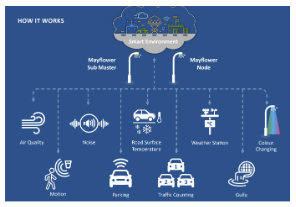
CMS control
For the adoption process it is common that Local Authorities are using Centrally Managed
Systems or (CMS). These are generally wireless systems using a node or master to control
many luminaires.
The technology may allow an adaptive lighting approach to roads, and increase levels
where high crime occurs
Variations on such systems exist, so compatibility must be checked in advance of procurement of items. Connectivity to such a system allows the authority the means to oversee and maintain operation
Electrical
Electrically, due to public budget controls it is unlikely, that maintenance of the electric
service may be passed to the DNO provider. The lighting columns would be connected
directly to an unmetered supply provided by the DNO (district electrical provider).
Reasons include operation usage codes required for energy, and CO² carbon offset. For
some signage and bollards, it may be agreed to provide an unmetered lighting point
from within a column or maybe a feeder pillar, constituting a Private Cable Network
(PCN) to these lighting points.

Obtrusive Light
Obtrusive light covers aspects that considers light performance and intensity through window, on patio areas or other similar areas where light may affect the enjoyment of that space.
In addition recent changes also include the effects of skyglow from shallow angle luminaires.
Accurate modelling in specific software is required to enable analysis of such effects. For detailed information, please refer to the specific guidance document related to this subject provided on the website and in published documentation.
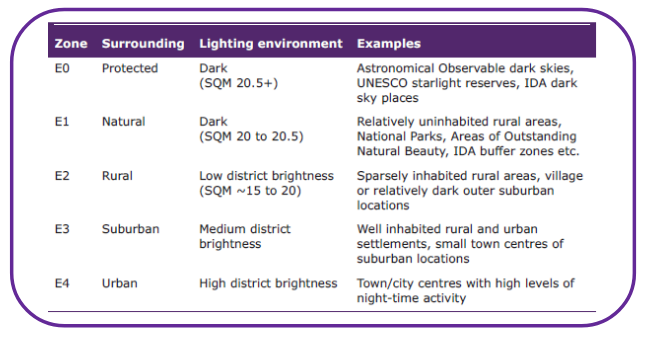
Environmental Zones
Based on scientific study, limitations exist on light emission based on population density and background illumination. Such limitations are present for hours of darkness prior to late evening (pre-curfew), and those of late evening into early morning (Post-curfew)
These environmental zones are described as follows:
Final Image Render